When Feedback Backfires: Why Good Intentions Still Miss the Mark
Most leaders believe they’re good at giving feedback because they show positive intent.
They want to help, support, and guide their people toward stronger performance, but intent alone doesn’t determine whether feedback is effective.
Feedback is defined by how it is received and what happens after the conversation.
If the message leads to confusion, defensiveness, or no meaningful change, something has obviously missed the mark.
Where Feedback Starts to Break Down
The most common issue is not tone, but translation.
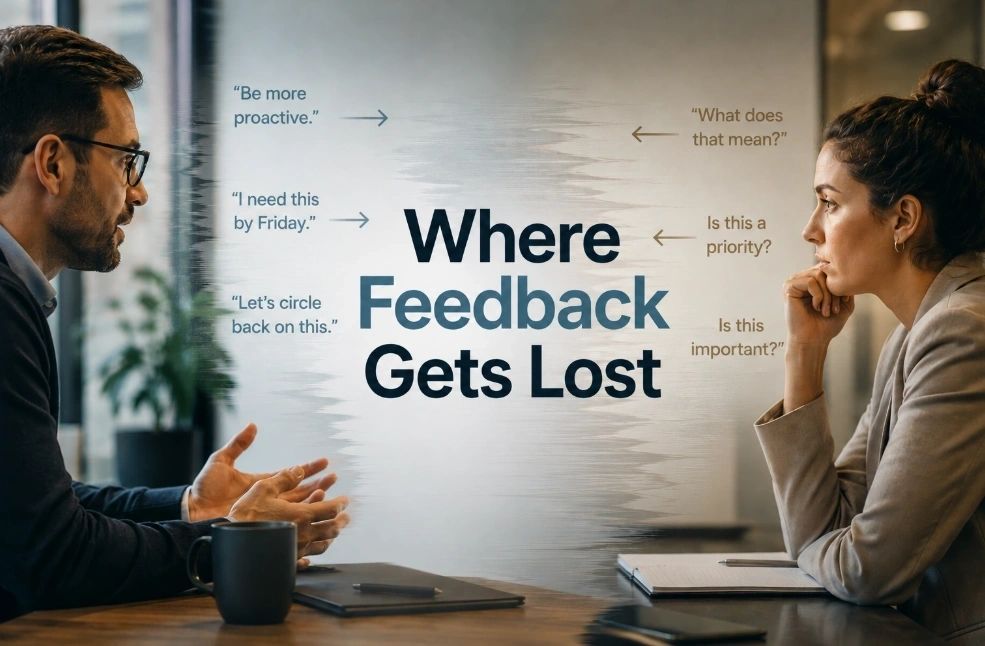
Leaders communicate with a specific outcome in mind, while employees interpret the message through their own lens. A manager might say, “I just want to give you some quick feedback,” believing it sounds casual, while the employee assumes something is wrong and prepares for criticism.
In other cases, a leader might say, “You need to be more proactive,” yet the employee leaves unsure of what that looks like in practice. Feedback falls short when it stays at a high level or relies on interpretation.
The leader understands the intent, while the employee is left to fill in the gaps.
Good Intentions Still Create Mixed Signals
Many well-meaning approaches are designed to soften feedback, but they often introduce confusion.
Phrases like “This isn’t a big deal, but…” leave the employee unsure how seriously to take the concern. “You’re doing great overall, just one thing…” can dilute the message. “Let’s circle back on this later” creates uncertainty when no specifics are provided.
These phrases are meant to make the conversation easier, yet they often make it harder to understand and act on.
The Gap Between What’s Said and What’s Heard
Employees interpret tone, timing, and context while trying to understand the broader implications.
They’re asking how serious the issue is, whether it reflects a pattern, and what success looks like going forward.
When those answers aren’t built into the conversation, feedback either creates unnecessary concern or is dismissed.
Being specific does more to strengthen feedback than adding more words.
What to Do Differently in the Moment
Start with observable behavior rather than interpretation.
Instead of saying, “You need to communicate better,” point to a recent situation: “In the last two project updates, the team did not receive status details until after deadlines shifted.”
Then connect it to impact: “Because of that, the team had to adjust timelines late, which created additional work and confusion.”
Define what should change next: “Going forward, I need those updates shared at least 24 hours in advance.”
Invite a response: “Is there anything getting in the way of that right now?”
Where Employees Play a Role
Feedback is not one-sided.
Employees shape how it’s interpreted and applied.
When feedback feels vague, asking for detail helps translate it into something usable. Questions like, “Can you walk me through a specific example?” or “What would you want to see done differently next time?” prevent assumptions from taking over.
The strongest teams treat feedback as an ongoing conversation rather than a one-time event.
Turning Feedback into Something That Works
When feedback doesn’t land well, the issue resurfaces with more frustration, creating hesitation and inconsistency across the team.
Effective feedback is direct, specific, and tied to outcomes. It respects the individual while addressing behavior in a way that can be acted on, and it shows up regularly as part of everyday leadership communication.
Employees don’t respond to intent. They respond to the impact of the conversation.
About Next Step Advisory
Next Step Advisory provides tailored HR solutions for small and mid-size businesses, from hourly consulting and defined projects to a full-service HR department by monthly subscription. Founder Debbie Rabishaw brings more than 35 years of HR leadership, practical judgment, and a genuine commitment to people and business.
To discuss how you can transform your HR challenges into strategic advantages, contact us today.